


A career with the EU?
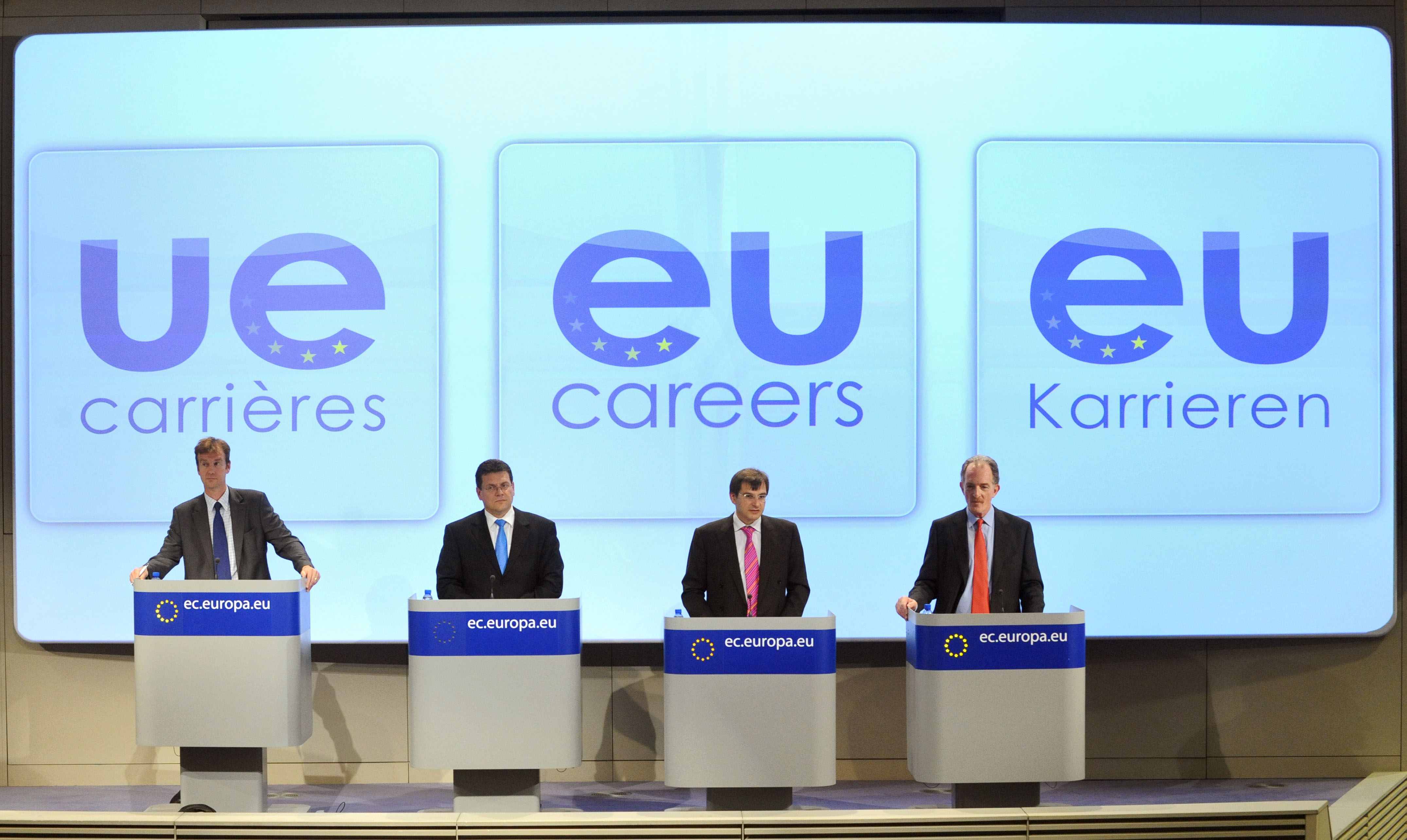
Photo: http://ec.europa.eu/avservices
Get you English up to speed to pass the tests and land that job!
Learn more about the structure of the EPSO competitions!
Need help sprucing up your CV and cover letter? Click here to see how we can help.
A career with the EU is an amazing opportunity to work in a stimulating and interesting, not to mention, multilingual environment and to have the opportunity to make a difference in your field. Before you can apply for a job, however, you will need to pass a series of tests that focus on different skills and competences. You may take some of the tests in your first language, which makes them a bit easier, but you will take most of the tests in a chosen second (or third) language.
Taking a test in English is twice the challenge as taking it in your first language, so you will probably need to prepare for it depending on your proficiency level. We can help you do just that.
Here is what you will find on our site to help you get ready for the EPSO competition:
Reading comprehension tasks that will make it easier for you to ace verbal and numerical reasoning tests.
Communication tasks that will help you practice for the situational judgement test.
Video lessons that will train your note-taking and comprehension skills needed for nailing the Assessment Centre tests.
We also offer skype sessions to help you prepare for the oral interview.
Sign up for our newsletter to get weekly updates and free lessons here.
Book skype sessions with us here.
Who’s who in the EU? – JUNCKER

Quite often, EU institutions and EU terms are hidden behind names, abbreviations or even word plays. So, if you do not know the key personalities of the EU (Tusk, Juncker, Mogherini, etc.) and the main concepts under discussion, you can hardly guess, what is actually meant by a newspaper headline....
Read MoreWhat’s a ZERO-SUM GAME? – Now I Know

A ZERO-SUM GAME is a situation in which what is gained by one person or group is lost by another. Here is an example that describes what a zero-sum situation is: To understand zero-sum games, it is helpful to think of the following example: If I have a slice...
Read MoreJob Interview – What to do with your Hands? – JOB HUNT

Having a good resume, an effective cover letter or being dressed properly for a job interview is just the beginning. But how to manage your HANDS ?? As you could see in our previous post, your BODY LANGUAGE also shapes who your are! So, if you really want to nail...
Read MoreTemporary Jobs – EPSONews&Terminology

If you wish to land a job with an EU institution, you need, first of all, to keep yourself up-to-date about ongoing open competitions and the terminology used in the description of available job profiles. So, the good news is, we can help you in both! Follow the EPSO NEWS...
Read MoreWho is the EU’s Foreign Policy Chief?

Who is the EU's foreign policy chief? Do you know? In this short video you can learn about the EU's top diplomat and her job. It comes with a quick, interactive listening quiz to help you get the main ideas. INTERACTIVE QUIZ Practice listening for key information (gist) about the...
Read MoreWhat’s it like to work for an EU institution?

This short video was published by EPSO, the European Personnel Selection Office, to advertise EU jobs. Watch the video and do a quick, interactive vocab quiz! Level: B1/B2 and above
Quiz-summary
0 of 6 questions completed
Questions:
- 1
- 2
- 3
- 4
- 5
- 6
Information
Do you remember the key words used to describe jobs, working environment and colleagues in this video?
You have already completed the quiz before. Hence you can not start it again.
Quiz is loading...
You must sign in or sign up to start the quiz.
You have to finish following quiz, to start this quiz:
Results
0 of 6 questions answered correctly
Your time:
Time has elapsed
You have reached 0 of 0 points, (0)
| Average score |
|
| Your score |
|
Categories
- Not categorized 0%
- 1
- 2
- 3
- 4
- 5
- 6
- Answered
- Review
-
Question 1 of 6
1. Question
1 pointsMy job is c…………….. = My job is demanding.
- (challenging)
Correct
Great!
Incorrect
-
Question 2 of 6
2. Question
1 pointsI am proud of my job because I can make a d…………… in the life of millions of people. = I can affect the life of millions of people through my job.
- (difference)
Correct
Well done!
Incorrect
-
Question 3 of 6
3. Question
1 pointsThere are a vast a…………. of jobs on offer at EPSO. = There are lots of different job offers at EPSO.
- (array)
Correct
Great job!
Incorrect
-
Question 4 of 6
4. Question
1 pointsThe working environment in EU institutions is unique because of its d…………….. . = The working environment is unique because many people from different countries work together in EU institutions.
- (diversity)
Correct
Good job!
Incorrect
-
Question 5 of 6
5. Question
1 pointsThe work of the EU institutions i……………. the life of more than 500 million people in Europe. = The work of the EU institutions affects the life of more than 500 million people in Europe.
- (impacts)
Correct
Good job!
Incorrect
-
Question 6 of 6
6. Question
1 pointsMy colleagues are professional and c…………… . = My colleagues are professional and devoted to their job.
- (committed)
Correct
Good job!
Incorrect
EPSO Practice – Numerical Reasoning Part 1

Unless you are a math whiz, it's tough to talk about statistics, graphs, numbers and trends in English. Download the pdf to practice the vocabulary of numerical reasoning tests - one of EPSO's favorite kind. Part 2 is coming soon All the questions refer to the statistics below: Source:...
Read MoreEPSO – NEWS & Terminology
A career with the EU is an amazing opportunity to work in a stimulating and interesting, not to mention, multilingual environment and to have the opportunity to make a difference in your field. If you wish to be part of this community and land a job with an EU institution,...
Read MoreFrench words in (EU) English QUIZ

Quiz-summary
0 of 6 questions completed
Questions:
- 1
- 2
- 3
- 4
- 5
- 6
Information
Take this quiz to find out which chic French words are often used in (EU) English!
You have already completed the quiz before. Hence you can not start it again.
Quiz is loading...
You must sign in or sign up to start the quiz.
You have to finish following quiz, to start this quiz:
Results
0 of 6 questions answered correctly
Time has elapsed
You have reached 0 of 0 points, (0)
Categories
- Not categorized 0%
- 1
- 2
- 3
- 4
- 5
- 6
- Answered
- Review
-
Question 1 of 6
1. Question
One of the leading bodies of the European Parliament (the other being the Conference of Presidents).
Correct
Good job!
Incorrect
Try again!
-
Question 2 of 6
2. Question
A long line of people who are waiting.
Correct
Good job!
Incorrect
Try again!
-
Question 3 of 6
3. Question
Open competition organized by the European Personnel Selection Office (or competition in general English).
Correct
Good job!
Incorrect
Try again!
-
Question 4 of 6
4. Question
In the European Commission, this is the personal office of a European Commissioner.
Correct
Good job!
Incorrect
Try again!
-
Question 5 of 6
5. Question
Traineeship with EU institutions and bodies of the EU.
Correct
Good job!
Incorrect
Try again!
-
Question 6 of 6
6. Question
The whole body of European Union law including the treaties, their amendments, legal acts, conventions, principles, etc. adopted by the EU.
Correct
Good job!
Incorrect
Try again!
Get EU Funding for Your Project

This short video will give you an overview of EU funding opportunities. Scroll down for a short quiz and a vocabulary list! Source: EuroParlTV
Quiz-summary
0 of 6 questions completed
Questions:
- 1
- 2
- 3
- 4
- 5
- 6
Information
Watch the video again if necessary, and answer the questions about the video.
You have already completed the quiz before. Hence you can not start it again.
Quiz is loading...
You must sign in or sign up to start the quiz.
You have to finish following quiz, to start this quiz:
Results
0 of 6 questions answered correctly
Your time:
Time has elapsed
You have reached 0 of 0 points, (0)
| Average score |
|
| Your score |
|
Categories
- Not categorized 0%
- 1
- 2
- 3
- 4
- 5
- 6
- Answered
- Review
-
Question 1 of 6
1. Question
1 pointsAn NGO is a non-governmental organization which means that it is neither a part of a government nor a conventional for-profit business although it may be be funded by governments, foundations, businesses, or private persons.
Correct
Incorrect
-
Question 2 of 6
2. Question
1 pointsEvery EU citizen is eligible for EU funding available in different fields of activity.
Correct
Incorrect
Many people may be eligible, but it depends on one’s field of activity whether or not they can apply for funding.
-
Question 3 of 6
3. Question
1 pointsOne principle of financial aid from the EU is that financial support cannot be paid for activities that have been finished.
Correct
Incorrect
-
Question 4 of 6
4. Question
1 pointsAnother important rule is that the EU does not pay for a project alone – the applicant must also have another source of financial aid.
Correct
Incorrect
-
Question 5 of 6
5. Question
1 pointsMore than 20 different structural and investment funds manage EU financial aid. One of these funds is the Cohesion Fund.
Correct
Incorrect
There are 5 large structural and investment funds one of which is the Cohesion Fund whose aim is the economic convergence of the regions within the EU.
-
Question 6 of 6
6. Question
1 pointsMicro-financing is a good option for self-employed people or small businesses with fewer than 10 employees. A micro-credit is a small loan of maximum 25,000 euro.
Correct
Incorrect
LuxLeaks – Whistleblowers in action

Who are whistleblowers? Are their actions illegal? Or are they protected by law? Find out more on this topic from the article below. The expressions highlighted in green are closely related to whistleblowers and help you understand the concept behind this term. You will also find some useful expressions to...
Read MoreEuropean Commission – Press release / Antitrust: Commission sends Statement of Objections to Google on comparison shopping service

This activity is a great opportunity for you to familiarize yourself with legal English and EU documents. Take 20 minutes, read the text and learn the most important words by reading the excerpts and doing the quick quiz! If you want to read the entire document, click here! European Commission...
Read MoreQUIZ on EU Multilingualism

Quiz-summary
0 of 9 questions completed
Questions:
- 1
- 2
- 3
- 4
- 5
- 6
- 7
- 8
- 9
Information
DO YOU KNOW who decides on multilingualism at EU level? What is the difference between multilingualism and plurilingualism? Or how many languages are spoken by the most multilingual person in the Commission? Check it out NOW, along with our detailed, learner-friendly explanations.
You have already completed the quiz before. Hence you can not start it again.
Quiz is loading...
You must sign in or sign up to start the quiz.
You have to finish following quiz, to start this quiz:
Results
0 of 9 questions answered correctly
Your time:
Time has elapsed
You have reached 0 of 0 points, (0)
Categories
- Not categorized 0%
- 1
- 2
- 3
- 4
- 5
- 6
- 7
- 8
- 9
- Answered
- Review
-
Question 1 of 9
1. Question
In EU terminology the term multilingualism refers to ……………….
Correct
That’s right! Source: http://ec.europa.eu/dgs/translation/translating/multilingualism/index_en.htm
Please also NOTE that the EU’s approach is different from that of the Council of Europe (another European organization founded in 1949). In the terminology of the Council of Europe two terms are used to describe these concepts. Multilingualism refers to linguistic diversity in a geographical region while plurilingualism refers to the linguistic repertoire and communicative competence of an individual.Incorrect
See more at http://ec.europa.eu/dgs/translation/translating/multilingualism/index_en.htm
Please NOTE that the EU’s approach is different from that of the Council of Europe (another European organization founded in 1949). In the terminology of the Council of Europe two terms are used to describe these concepts. Multilingualism refers to linguistic diversity in a geographical region while plurilingualism refers to the linguistic repertoire and communicative competence of an individual. -
Question 2 of 9
2. Question
The total cost of translation and interpretation in all the EU institutions (including the European Commission, European Parliament, Council, Court of Justice of the European Union, European Court of Auditors, European Economic and Social Committee, Committee of Regions) is around €1 billion per year. This represents less than …………………………… of the EU budget or just over €2 per citizen.
-
Question 3 of 9
3. Question
The EU has ……………………. official languages (as in 2015).
Correct
That’s correct! The EU has 28 Member States and 24 official languages (as in 2015)
Incorrect
The EU has 28 Member States and 24 official languages (as in 2015)
-
Question 4 of 9
4. Question
There are ……………………….. official languages than Member States.
Correct
That’s right! Some languages are widely spoken and recognized as official languages in more than one country (French, German, Swedish – just to mention a few examples).
Incorrect
Some languages are widely spoken and recognized as official languages in more than one country (French, German, Swedish – just to mention a few examples).
-
Question 5 of 9
5. Question
The European Commission conducts its internal business in English, French and German, commonly referred to as ‘…………………………………….’ languages.
Correct
That’s right! Please NOTE that Council Regulation 1/1958 on the status of languages at EU level does not differentiate between official and working languages. All of the languages listed in Regulation 1/1958 are referred to as ‘official languages and working languages’. However, the Regulation also provides for the opportunity to determine which languages EU institutions may use in their internal work processes. These languages are called ‘procedural languages’, or simply ‘working languages’.
Incorrect
Please NOTE that Council Regulation 1/1958 on the status of languages at EU level does not differentiate between official and working languages. All of the languages listed in Regulation 1/1958 are referred to as ‘official languages and working languages’. However, the Regulation also provides for the opportunity to determine which languages EU institutions may use in their internal work processes. These languages are called ‘procedural languages’, or simply ‘working languages’.
-
Question 6 of 9
6. Question
The EU encourages every European citizen to know at least ………………………… foreign languages in addition to their mother tongue.
Correct
That’s right! The “mother tongue+2 model” goes back to the Barcelona European Council in March 2002, where the Heads of State or Government called for at least two foreign languages to be taught from
a very early age.Incorrect
The “mother tongue+2 model” goes back to the Barcelona European Council in March 2002, where the Heads of State or Government called for at least two foreign languages to be taught from
a very early age. -
Question 7 of 9
7. Question
There are round ……………… minority and regional languages spoken in the European Union.
-
Question 8 of 9
8. Question
Who decides on the official status of languages at EU level?
Correct
That’s right! The Council of the EU decides on the status and use of languages at EU level unanimously. In other words, every Member State has a veto right in this issue.
Incorrect
The Council of the EU decides on the status and use of languages at EU level unanimously. In other words, every Member State has a veto right in this issue.
-
Question 9 of 9
9. Question
Ioannis Ikonomou, a translator and the most multilingual person in the European Commission, speaks ……………………………… languages.
Harmony of Babel – Multilingualism in the EU

With 24 official languages (and counting), and over 60 indigenous regional or minority languages, the EU truly is a paradise for language enthusiasts! Many Europeans benefit from growing up speaking more than one language either because their country is officially multilingual (e.g., Belgium or Luxembourg) or for a number of...
Read MoreEuropean Citizens’ Initiative – QUIZ

Do you have an idea that you'd like to call the EU's attention to? Maybe about an issue concerning public health or the environment? The good news is: If you'd like to change the legislation of a particular matter close to your heart, you can. You just need to know...
Read MoreEPSO Prep – Numerical Reasoning Test – Part 2
When it comes to numerical reasoning tests, understanding the expressions, abbreviations and concepts they use is half the battle. Take this quiz to see if you are on top of things when it comes to the expressions & ideas used in the statistics below. Download the handout here if you'd...
Read MoreEU grants and tenders – What’s the difference?

Are you in doubt when using terms and expressions related of EU funds and contracts? Click here to clear up your confusion! Featured image courtesy of Stuart Miles at FreeDigitalPhotos.net
Read MoreAbout the EPSO Exam

The EPSO competitions explained: Read this short summary to get the picture! Image courtesy of ec.europa.eu/avservices
Read MoreEU Abbreviations QUIZ

Quiz-summary
0 of 8 questions completed
Questions:
- 1
- 2
- 3
- 4
- 5
- 6
- 7
- 8
Information
EU Abbreviations Quiz – Do you know the short for the following?
You have already completed the quiz before. Hence you can not start it again.
Quiz is loading...
You must sign in or sign up to start the quiz.
You have to finish following quiz, to start this quiz:
Results
0 of 8 questions answered correctly
Time has elapsed
You have reached 0 of 0 points, (0)
Categories
- Not categorized 0%
- 1
- 2
- 3
- 4
- 5
- 6
- 7
- 8
- Answered
- Review
-
Question 1 of 8
1. Question
The European job mobility portal.
Correct
Good job!
Incorrect
Try again!
-
Question 2 of 8
2. Question
The portal that gives free access to EU law.
Correct
Good job!
Incorrect
Try again!
-
Question 3 of 8
3. Question
The Economic and Financial Affairs Council.
Correct
Good job!
Incorrect
Try again!
-
Question 4 of 8
4. Question
The personnel selection office of the EU.
Correct
Good job!
Incorrect
Try again!
-
Question 5 of 8
5. Question
The European Anti-Fraud Office.
Correct
Good job!
Incorrect
Try again!
-
Question 6 of 8
6. Question
The European Atomic Energy Committee.
Correct
Good job!
Incorrect
Try again!
-
Question 7 of 8
7. Question
Interactive Terminology for Europe. The official terminology database of the European Union
Correct
Good job!
Incorrect
Try again!
-
Question 8 of 8
8. Question
The EU’s diplomatic service.
Correct
Incorrect

